.webp)
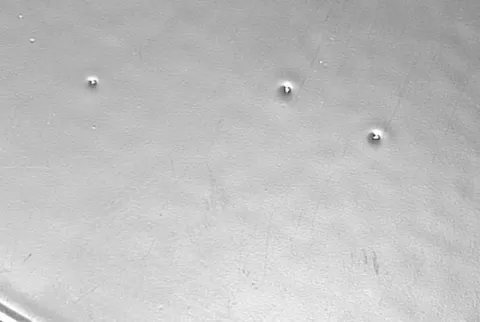
Aperfectly coated surface is smooth, glossy, and uniform—a visual testament to precision and quality. But even in the most advanced powder coating processes, imperfections like craters and pinholes can appear, marring the finish and raising questions about process control. At Sharp Coatings, with over 25 years of experience in powder manufacturing and application support, we've seen these issues countless times. We've helped hundreds of companies eliminate them. Understanding the science behind craters and pinholes is the key to flawless results.
What are the differences between craters and pinholes?
Though often mentioned together, craters and pinholes are two distinct surface defects that occur during powder coating curing.
1. How craters threaten clean coatings
Craters are small, circular depressions often surrounded by a raised rim. They're caused by surface tension disturbances when a contaminant on the surface prevents the molten powder film from leveling properly during curing.
2. The problem of trapped gas in pinholes
Pinholes look like tiny, evenly distributed holes on the coating surface. They form when air, moisture, or gas escapes from the substrate during the curing process. The film solidifies before the gas escapes completely.
A visual indicator of craters and pinholes
A process-driven approach to craters and pinhole prevention
Preventing these defects is not about fixing them afterwards—it's about controlling every variable before application. Sharp Coatings recommends the following best practices for consistent, defect-free finishes:
1. Ensure clean, dry, and oil-free compressed air
The compressed air you use is just as important as the powder itself. Moisture or oil vapor can easily enter the gun or hopper, contaminating the powder and finish.
2. Perfect your surface preparation
Surface prep is the foundation of coating quality. Even the finest powder can't adhere to an oily, dusty, or chemically unbalanced surface.
3. Control film thickness
Excessive film thickness prevents trapped gases from escaping.
4. Use degassing formulations for porous substrates
For cast metals or outgassing-prone substrates, use specially designed degassing powder coatings. Sharp Coatings' Degassing Powder Series allows trapped gases to escape during curing, preventing pinholes while maintaining mechanical and chemical performan
5. Bake with precision
Curing ovens must maintain accurate and uniform temperature control.
6. Keep equipment and booths immaculate
In powder booths, contamination control is just as critical as in cleanrooms.
Advanced troubleshooting tips
The Sharp Coatings advantage
Every powder formulation we produce—from Epoxy-Polyester blends to Architectural Super Durable Polyesters—is designed for optimal flow, leveling, and contamination resistance.
Prevention is the real cure
Craters and pinholes are symptoms, not problems themselves. They signal underlying issues with cleanliness, the environment, or process control. By addressing contamination, managing cure, and choosing the right powder chemistry, coaters can prevent thes